Cover Art Three Months Residence at Nablus and an Account of the Modern Samaritans

A priest lifts a Samaritan Torah ringlet during sunrise prayers on Mount Gerizim in the Westward Banking concern. 1 of the world'due south oldest and tiniest sects, the Samaritans trace their roots to the ancient Israelites. Tanya Habjouqa/Noor Images for NPR hibernate caption
toggle caption
Tanya Habjouqa/Noor Images for NPR

A priest lifts a Samaritan Torah scroll during sunrise prayers on Mount Gerizim in the W Bank. 1 of the earth's oldest and tiniest sects, the Samaritans trace their roots to the ancient Israelites.
Tanya Habjouqa/Noor Images for NPR
Earlier dawn on March 21, 1995, someone bankrupt into a synagogue in the Palestinian metropolis of Nablus.
The thief — maybe it was a ring of thieves — crossed the carpeted sanctuary, pulled back a heavy velvet drape, and opened a carved wooden ark. Inside were two handwritten copies of the Torah, the Five Books of Moses. 1 was a sheepskin curl written around 1360 and kept in a slender copper case. The other was a codex, a thick volume, probably from the 15th century and bound in a maroon leather encompass. The thief or thieves snatched the manuscripts, escaped through the synagogue's arched doorway, discarded the copper case in a stairwell, and vanished.
These were no ordinary texts. They were maybe the near ancient Torahs stolen in the Holy Land since the Crusaders pillaged Jerusalem. And they belonged not to Jews but to the Samaritans, one of the earth'due south oldest and tiniest religious sects. Known from the New Testament parable of the Proficient Samaritan, the group has barely survived. Centuries agone, information technology numbered more than i meg; today, according to the last count, at that place are only 810 Samaritans left.

(Peak) Samaritans assemble for a sunrise pilgrimage to gloat the Festival of Tabernacles. (Left) Carpets were placed on the mountain during the pilgrimage. (Right) Ruins on superlative of Mount Gerizim, simply before sunrise. Tanya Habjouqa/Noor Images for NPR hibernate caption
toggle caption
Tanya Habjouqa/Noor Images for NPR
The Samaritans trace their roots to the ancient Israelites and regard themselves equally the most loyal followers of the word of God as transmitted to Moses. Women are kept apart from others when menstruating in adherence with ritual purity, and men cede sheep each year on Passover, a biblical commandment Jews gave up millennia ago.
If the Samaritans are the true keepers of the biblical faith, their Torahs are championship deeds: rare and sacred manuscripts, written in a variation of the original Israelite script that Jews abandoned long agone and featuring passages scholars say preserve some of the primeval drafts of the Bible. Of the three dozen old biblical manuscripts left in the community's coffers, the Samaritans say one is the oldest in the world, written by Moses' great-grandnephew. These manuscripts are the Samaritans' near jealously guarded possessions, and collectors across the globe have gone to great lengths to go their easily on them.
And so have thieves.
Discussion of the burglary spread fast. Some 30 miles southwest, a Samaritan named Benyamim Tsedaka — everyone calls him Benny — left his domicile in State of israel and collection straight to the W Bank, to the scene of the crime. Benny didn't know information technology then, only he would soon embark on a years-long international hunt for the missing Torahs. The hunt would eventually beckon me, likewise. The search would take u.s.a. deep into the illicit antiquity trade, where ancient manuscripts take more than than just spiritual value.
Like aboriginal times
I first met Benny 10 years agone on a trip with friends to the Samaritans' West Bank village, perched on Mount Gerizim overlooking Nablus. Benny has a second home on the mountain, and we were chop-chop shepherded into his living room, just like many other diplomats, journalists, academics and marvel seekers.

Benyamim "Benny" Tsedaka is a prolific writer on Samaritan traditions. He introduces himself equally a 125th-generation Samaritan. Claire Harbage/NPR hide caption
toggle caption
Claire Harbage/NPR
Benny is a prolific author on Samaritan traditions and published the get-go English language translation of the Samaritan Torah, which differs slightly from the Jewish version in thousands of instances. Benny is also editor of a Samaritan community newspaper and a 1-man foreign ministry, hosting dignitaries and giving lectures effectually the world about his community. He speaks in oratorical English with a singsong Israeli accent, cracking jokes nigh the poor sheep sacrificed on Passover and complimenting his female guests on their beauty. He's 73 years one-time, with a tan complexion and a thin white mustache framing a gap-toothed smiling. "If you want to go to the roots, you take to meet a Samaritan," I one time heard him explain to a group of British Jews. "When y'all meet the Samaritans ... you tin can run into how your real forefathers lived in the old times."
He introduces himself equally a 125th-generation Samaritan, significant a descendant of the original Israelites who settled in Samaria, the area of the Holy Land where the Bible says the Israelites erected their starting time altars of worship. In the center of Samaria is the biblical Mountain Gerizim, the Samaritans' sacred mountain, which they accept clung to for centuries. The ancient Jews based their center of worship most xxx miles due south in Jerusalem, but Samaritans consider that an aberration of the Israelite tradition; indeed, Jerusalem is never explicitly named in the V Books of Moses. Mount Gerizim is. Jewish tradition, meanwhile, said Samaritans were impostors of foreign descent. Jews and Samaritans sparred over the biblical birthright for centuries; the parable of the Good Samaritan was Jesus' way of teaching his disciples that even a rival could be kind.
Today, the Samaritans' dwelling on Mount Gerizim places them in one of the nearly volatile corners of the West Bank. To get there, you lot bulldoze past landmarks of the Israeli-Palestinian disharmonize: Palestinian villages, Israeli armed services checkpoints, and some of the West Bank'south nigh hard-line Jewish settlements.

Young Samaritans stand on meridian of Mount Gerizim after the sunrise pilgrimage. The Samaritan community used to number more than than 1 million; today, according to last official count, in that location are but roughly 800 left. Tanya Habjouqa/Noor Images for NPR hide caption
toggle explanation
Tanya Habjouqa/Noor Images for NPR

Young Samaritans stand up on top of Mountain Gerizim afterward the sunrise pilgrimage. The Samaritan community used to number more than ane one thousand thousand; today, according to concluding official count, there are only roughly 800 left.
Tanya Habjouqa/Noor Images for NPR
I started making regular visits, to watch Samaritan men in white holiday robes joyfully mark each other's foreheads with sheep's blood during the Passover cede, to see a bearded priest thrust a Torah scroll toward the heavens during a sunrise ceremony held three times a year. Fifty-fifty with the jostling phalanx of photographers and tourists, I couldn't aid being moved past these ceremonies. They seemed 18-carat and pure, a glimmer of an ancient past.
V years ago, during one of my visits with Benny, he told me about the theft of the Torahs, dramatically unspooling the details as if narrating the opening lines of a novel. And so he said he was pursuing a new lead in the example.
Who stole the Torahs? Why? And what would it take to get them back? The mystery was irresistible — a tale of looted manuscripts and an ancient tribe's quest to retrieve them. I began to shadow Benny on his mission.
Torahs sold for bread
The disappearance of the holy books in 1995 was not the get-go time the Samaritans had been robbed. As Benny explained it to me, outsiders had plundered the community's treasures for centuries. Sometimes it was by deceit: In 1671, an English manuscript collector tricked the Samaritan high priest into giving him a Torah scroll to deliver to a fictitious Samaritan customs in England. More often, it was through pressure and money. In 1864, for example, Samaritan priests quietly sold a Russian collector i,348 manuscripts and assorted antiquities. Collectors were intrigued by the Scriptures and what they might teach about the history of the Bible. The Samaritans consider it a sin to surrender their holy texts, but some sold them in surreptitious. In full, Benny estimates nigh 4,000 Samaritan manuscripts were sold in the late 19th and early on 20th centuries, hauled away to the Vatican, Russia's National Library in Petrograd, Oxford University, Michigan State University and other corners of the globe.
Benny has a sympathetic accept on the Samaritans who hawked their ain manuscripts. "People tore leaves from the Torah books to sell them and eat something. For bread," he explained to me. He says his people did this for survival. The Samaritans had barely outlasted centuries of persecution, conversion and the struggle of living autonomously. Their uncompromising loyalty to tradition and to the purity of their bloodline came at a loftier price. Centuries of insularity led to inbreeding and disabled offspring, and those who gave upward the Samaritan faith or married outside the customs were excommunicated.

Tsedaka helps libraries around the earth itemize or assess their Samaritan collections. Claire Harbage/NPR hibernate caption
toggle explanation
Claire Harbage/NPR
Samaritans no longer need to sell their aboriginal manuscripts, Benny says. The customs has flourished, in no small office thank you to the efforts of his ain family. His grandad'southward friendship with Israel'due south second president helped secure the Samaritans their ain tract of land in Holon, a suburb of Tel Aviv, and his grandfather'due south ties to an American benefactor helped sustain the impoverished community during tough times. Today, Samaritans are traders and tahini-makers, and the community has slowly rebounded in numbers, assuasive men to ally outsiders who commit to the strictures of Samaritan life.
Benny takes swell pride in his family'south historic contributions and shares the same sense of duty. He has led delegations of Samaritan elders to libraries around the world to view Samaritan texts sold long agone. He is amongst a select few in the globe who tin can read the Samaritan Hebrew alphabet, and libraries oft phone call upon him to catalog or appraise their Samaritan collections. He knows the texts like no one else does.
I've watched Benny crane his neck over Samaritan parchments. They are not just historical documents to him; they are role of the Samaritan family unit tree. Torah scribes enciphered their names within the text, so Benny knows who wrote each one. Often he can identify the scribe by the handwriting solitary. Many old texts serve every bit tombstones, mentioning the names of Samaritan families who died out long ago.
One manuscript eluded 19th century collectors' attempts to purchase information technology: the fabled Abisha scroll, which Samaritans believe is the oldest Torah in existence, written by Moses' great-grandnephew. It was not for sale. For a fee, visitors to the Samaritan synagogue in Nablus were allowed a glimpse. An ornate case would be opened to reveal a crinkly scroll. Just it was a decoy. Instead of the famous Abisha scroll, visitors were shown a 14th century Torah whorl written by another scribe named Abisha. Amongst themselves, Samaritans called information technology the "tourists' Torah."
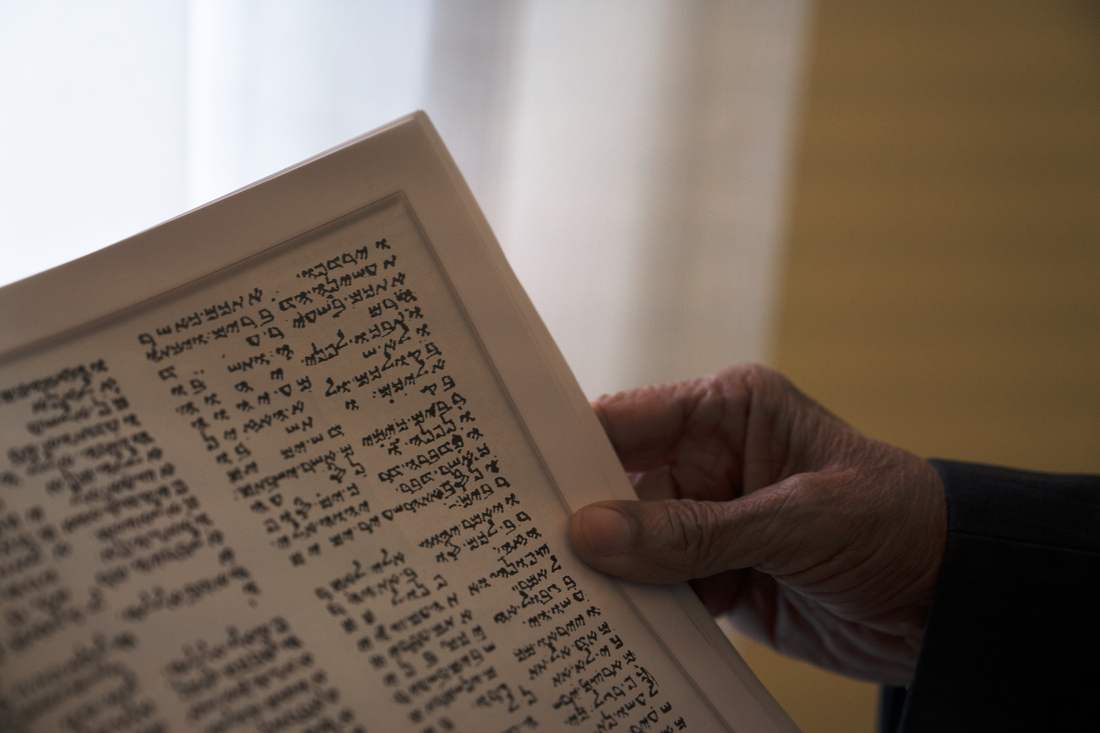
Tsedaka holds a reproduction of a Samaritan text. He lectures around the world well-nigh Samaritan history. Claire Harbage/NPR hide explanation
toggle caption
Claire Harbage/NPR
It was the tourists' Torah that disappeared in 1995. The thieves probably thought they were hauling away the oldest Torah in the earth.
"Betwixt the raindrops"
The forenoon afterwards the break-in, Palestinian officials arrived at the Nablus synagogue to condolement Benny and a grouping of Samaritan elders. Palestinian leader Yasser Arafat himself telephoned, vowing to root out those responsible. When the Palestinians left, the Israelis arrived — soldiers, police officers, and agents from Israel's domestic intelligence service. They, likewise, assured the Samaritans they would swiftly apprehend the thieves.
Information technology was not surprising that Israeli and Palestinian officials both rushed to the scene of the offense. The Samaritans straddle the political split up. Half alive as Israelis in one pocket-sized Samaritan neighborhood in the working-class Israeli town of Holon, speak Hebrew and serve in the Israeli regular army. The other half alive as Palestinians on their holy mountain in the West Bank, speak Arabic and piece of work in the Palestinian city of Nablus. The Samaritans of the West Banking company carry both Palestinian and Israeli ID cards and acquit both Standard arabic and Hebrew names. Information technology tin pb to delightful hybrids; i beau I know is named Abdullah Cohen.

Young Samaritans look exterior a grocery across the street from the Samaritan synagogue on Mount Gerizim. Samaritans straddle the political divide: Half alive as Israelis in i pocket-sized Samaritan neighborhood. The other one-half alive equally Palestinians on their holy mountain in the W Banking company. Tanya Habjouqa/Noor Images for NPR hide explanation
toggle explanation
Tanya Habjouqa/Noor Images for NPR
Palestinian leaders embrace the Samaritans as an instance of the Palestinian people's tolerance, diversity and deep roots, while Israeli leaders embrace the Samaritans as living proof of Jewish history in the W Banking company. The Samaritans are poised betwixt these two adversaries, and dependent on both. It's a matter of survival, reflected in Benny's own family: His brother is an activist in Israeli Prime Minister Benjamin Netanyahu's bourgeois political party, while his cousin is a civil servant of the Palestinian Authority.
As Benny likes to say, Samaritans must walk betwixt the raindrops.
"I desire him destroyed, like Lot's wife"
"There is a certain development in the affair of the two stolen Torahs," Benny'due south newspaper, A.B Samaritan News, reported in the summer of 1995, a few months after the theft. "The hour of their return to the Samaritans is very near."
Palestinian leader Arafat had taken on the case. His confidants had contact with men in Jordan who had the manuscripts and were demanding $7 million for their return. Past autumn, Arafat had told Samaritan elders the thieves had dropped their bribe demand to $2 meg. Over the adjacent couple of years, prominent Samaritans were summoned to the Jordanian capital of Amman to view the stolen Torahs. One businessman was reportedly shown the Torahs in a parking lot effectually midnight. Another, Saloum Cohen, a Samaritan friend of Arafat's appointed to the Palestinian parliament, was said to accept nearly cried when a masked homo in Amman opened a briefcase and showed him the captive manuscripts. Simply the Samaritans always came back empty-handed, unable to afford the steep bribe.
"It is all suspicious," Benny told me recently. The shadowy viewings in Amman seemed like a charade, and Arafat appeared to be more interested in negotiating over the ransom than seeking the manuscripts' return. The Samaritans had no selection merely to cooperate. In the aftermath of the Oslo peace accords of the mid-1990s, and just months after the Torah theft, Arafat's newly formed Palestinian Say-so government took accuse of the Nablus area from the Israeli military, and the Samaritans of the West Bank savage under Arafat's rule.
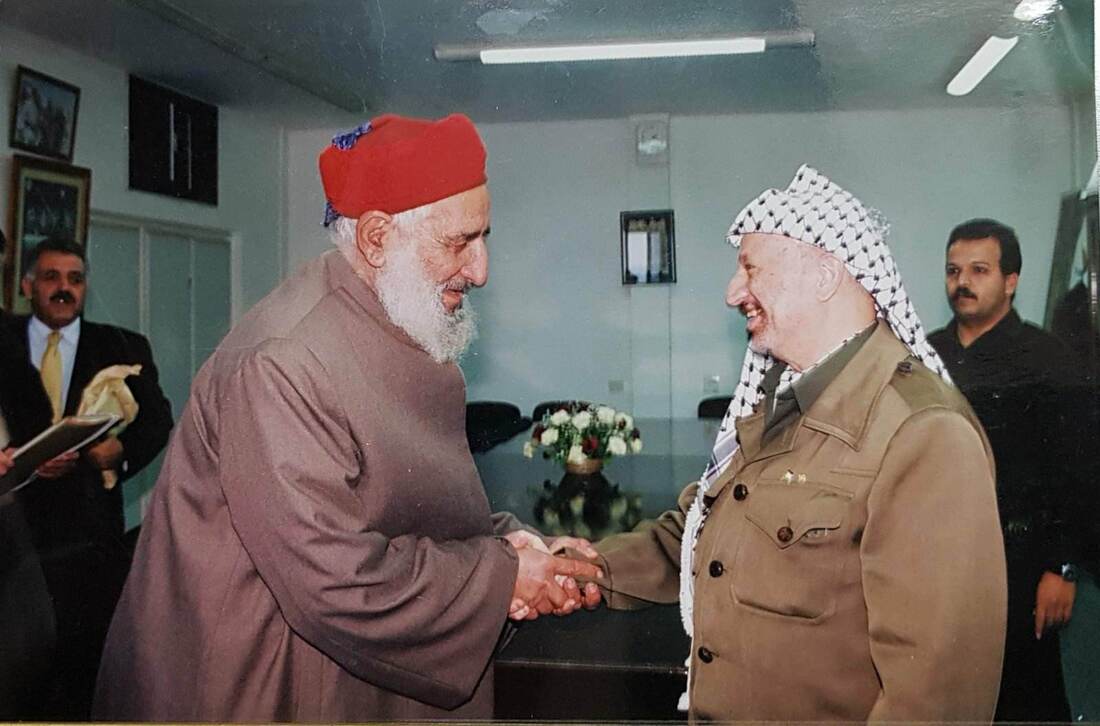
Samaritan priest Saloum Cohen greets Palestinian leader Yasser Arafat in 1998. After the theft, Arafat vowed to root out those responsible. Courtesy of Shoroq Cohen hide caption
toggle explanation
Courtesy of Shoroq Cohen
In the years that followed, Benny tried diplomatic channels. He organized a meeting with Israeli Foreign Ministry officials, sought help from Netanyahu, and enlisted British lawmakers to petition the Jordanian king's brother. His efforts yielded nothing. Eventually, the Israeli constabulary said they closed their investigation because of a lack of evidence and purged the case file.
Samaritans tried to forget the whole thing, though if you lot raise the topic, the anger resurfaces. "Whoever stole it, I want him destroyed, like Lot's married woman," one Samaritan one time told me, vowing biblical vengeance.
In the summer of 2011, Benny received a telephone call. An Israeli antiquities dealer in Jerusalem had received two video files of Samaritan manuscripts for sale. The Israeli dealer frequents parts of the Middle Due east where trading in antiquities is outlawed and can land someone in trouble, and then he didn't desire his proper name revealed. I'll telephone call him the Dealer.
The Dealer asked Benny to appraise the manuscripts. In the first video, olive-toned hands roll out a splotchy curl atop a vino-cherry tablecloth. In the second video, the aforementioned hands leafage through a large codex. The videos were filmed in silence, save for the crackle of the parchment.
Benny recognized the penmanship. The stolen Torahs had resurfaced.
At present all the Dealer had to do was get them back.
The Hunt
In early on 2013, I traveled with the Dealer to Amman, where the two stolen Torahs had been brought afterwards the theft.
The Dealer had arranged to come across the thieves' frontman, a retired Palestinian police officer residing in the Jordanian majuscule. Simply when nosotros sat in the frontman'due south living room, he said he didn't have either of the Torahs. He alleged that the 14th century Torah scroll had been moved across the border to Syria. The Dealer groaned and we left. I was skeptical that we had gotten the total story.
The Dealer had gotten a tip that the other stolen Torah, the 15th century codex, had been moved from Amman to London. The city is a frequent destination for antiquities looted in the Middle Due east, because of its colonialist legacy, permissive laws on collecting and concentration of wealthy buyers.
According to the Dealer, a London antiquities merchant had told him: "I bought the Samaritan Bible, only I forgot where I put it." It was the playful and slippery lingo of the antiquities trade, in which looted relics are often bought and sold in the shadows. Benny was traveling to London to lecture nearly the Samaritans, and the Dealer arranged to come across him there to confront the antiquities merchant about the codex. I was invited to come up along. But once we were within his cramped London shop, the merchant denied whatsoever knowledge of the Samaritan codex or its whereabouts, and we left.
It was nevertheless some other dead terminate.
According to the Dealer'south informants in London, the merchant sold the codex to cover a debt. At that place were 2 prominent Israelis in London with an interest in Samaritan manuscripts. The kickoff was Shlomo Moussaieff, a diamond magnate who had amassed some sixty,000 biblical and Jewish antiquities in his quest to prove the historical veracity of the Bible. I phoned his London home, and he asked me to come at once.
Wilma, his Filipina caregiver, answered the door. I walked into a big foyer flanked past Romanesque columns and vitrines stacked four levels high with miniature glass vases and votive carvings. Moussaieff, then xc years old, was slumped in a plush loveseat, holding two polished black coins in his right hand and a cigarette in his left.
I asked him about the stolen Samaritan codex. "That's mine!" he squawked, so trailed off nigh shards of 3,000-twelvemonth-old glass. Each fourth dimension I pressed for details, he proffered a different story. The patriarch of the Armenian church in Jerusalem sold information technology to him. No, a Samaritan priest'south daughter sold it to him. No, he hadn't bought it at all. I left unsure whether I had been treated to the sleight of hand of an ace collector or to the shifting memories of an sometime man's muddled listen. He died a few years later on.
The second homo on my list was the Jerusalem-born investor David Sofer, a descendant of an important rabbinic scholar and the owner of an enviable collection of rare manuscripts. He invited me to view his drove. Dissimilar Moussaieff'southward flat of swirly upholstery and colored marble, Sofer's London home was decorated in creamy white. He disappeared into a side room and brought out a thick Samaritan Torah codex written on vellum, and a long strip of parchment from an old Samaritan Torah scroll. Neither was i of the stolen Torahs. "I don't purchase manuscripts and books from fly-by-night, passing-by people," Sofer said.

Samaritans assemble in a synagogue in the middle of the night earlier marching to the top of Mount Gerizim. Many collectors accept the desire to ain a remnant of biblical history. This desire turned Samaritan holy books into luxury bolt. Tanya Habjouqa/Noor Images for NPR hide caption
toggle caption
Tanya Habjouqa/Noor Images for NPR
The two collectors could not have been more different in character, simply both embodied the centuries-quondam fascination with the Samaritans' literary treasures. Merely similar the commencement Europeans who collected Samaritan Scriptures, their desire to own a remnant of biblical history was wrapped upward in their quest to verify the Sometime Testament. This desire turned holy books into luxury commodities. Only both denied acquiring the stolen Samaritan texts.
The trail had gone cold.
A Sale?
I returned to where the story began: with the Samaritans of the West Banking concern. On a blustery Sabbath weekend one winter, Benny lent me the keys to his second home on Mount Gerizim, where Samaritans live in small-scale, limestone-covered houses huddled around one main village road. I stumbled through the mountain mist, upwardly and downwards the route, knocking on doors.
Khader Cohen, a member of 1 of the community'southward three priestly families, invited me into his living room. He was a cantor at the Samaritan synagogue and the last person to return the Torahs to the ark before the theft. He said he had locked the ark and placed the key on top, equally he always had done. Only a Samaritan who attended prayers would have seen him do that, he said. Plus, the copper Torah case, found discarded outside the synagogue, would have been complicated to detach from the coil; whoever did it would have had to remove its ornamental crowns and slide out its two long dowels. But those experienced handling a Samaritan Torah would have been able to do so, and only members of the Samaritan priestly course handled Samaritan Torahs, he said. Though Benny had reported in his newspaper that the thieves had bludgeoned the padlock on the synagogue door, and stood past his recollection, Cohen swore information technology had merely been unlocked.

Samaritans pray among ruins at the acme of Mount Gerizim in the West Bank. Tanya Habjouqa/Noor Images for NPR hide caption
toggle caption
Tanya Habjouqa/Noor Images for NPR
Cohen would non proper noun names. Instead, he posed iii questions about the thief or thieves: "How did he know how to accept off the crowns? How did he know the central was above the ark? And the third question: How did they open the padlock?"
Nearly every Samaritan I met that weekend suspected one of their ain was behind the theft. The older generation refused to point fingers. Some younger Samaritans, nonetheless, offered up names of prominent members of priestly families, though they provided no evidence. The Torah theft was no theft, they insisted: It was a sale. One young community fellow member alleged these Samaritans had colluded with Palestinian criminals, duping them to believe they were selling the world's oldest Torah, the Abisha.
I visited 1 of the men who had been named every bit a suspect.
This Samaritan was 1 of several in the customs who owned old manuscripts. His family unit used to have more, he said, but sold Torahs to foreign collectors several generations ago — the familiar story of manuscript peddling. Today, he said, he would never cartel to sell ane.
Merely other items are for auction. He sent his immature nephew to fetch a small box of chaplet he said were from aboriginal Assyria and asked if I would similar to buy them. And he one time dabbled in Samaritan fortunetelling. Throughout the Eye Eastward, Samaritans of priestly stock have long been viewed as wielding supernatural powers of prediction; to this twenty-four hours, Palestinians, Jordanians and other Middle Easterners pay Samaritans for palm readings and amulets handwritten in their ambiguous Hebrew script. Several Samaritan priests now make their living every bit fortunetellers. "Between us, it was a scam," he said of his clairvoyance business concern.
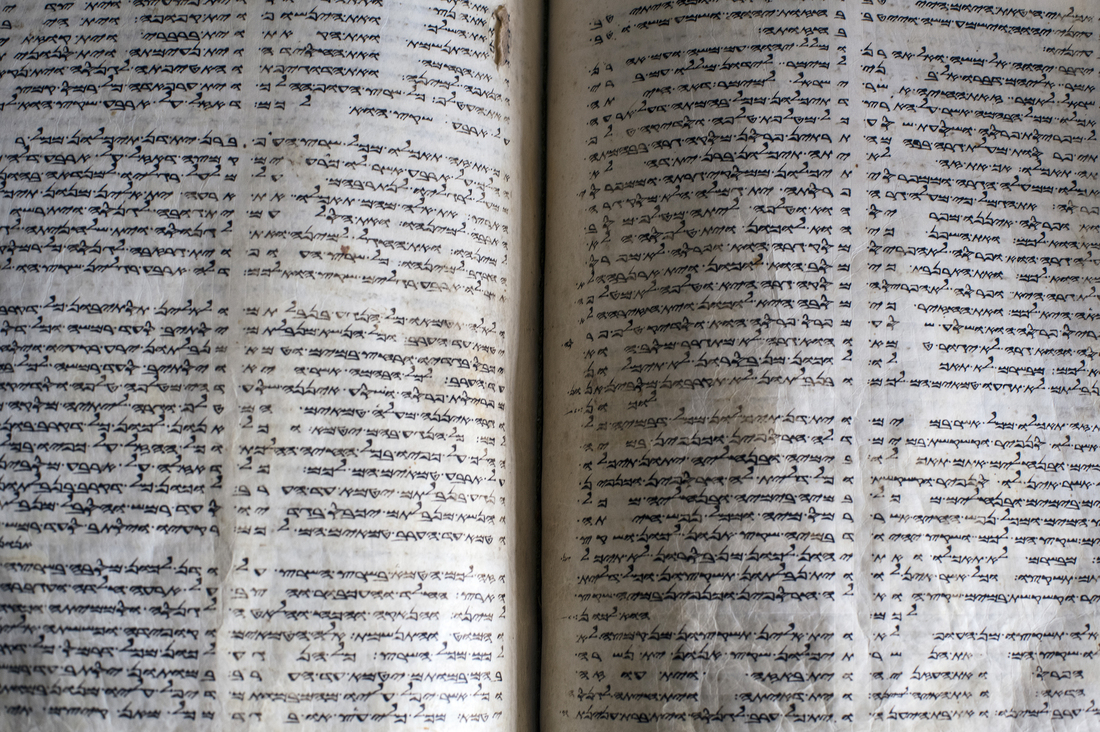
An former Samaritan Torah codex. Twenty-three years afterwards, the theft all the same divides some of the most prominent members of this tiny sect. Tanya Habjouqa/Noor Images for NPR hibernate caption
toggle explanation
Tanya Habjouqa/Noor Images for NPR
He seemed an unlikely thief; like others, he said he had taken an involvement in trying to get the Torahs back. I told this to a young Samaritan on the mountain. "Let me tell you lot a story," he replied.
In the Torah, he said, Jacob's sons plotted to kill their brother Joseph. The eldest brother, Reuben, persuaded them to throw Joseph into a pit instead. The reason, the young Samaritan said, was that Reuben wanted to return Joseph to his father, so his begetter would forgive Reuben for what they had done.
The young Samaritan'due south implication was clear: Like the biblical Reuben, these Samaritans may have sought to call back what they had sold to articulate their conscience.
I asked the man I visited, one of those suspected past fellow Samaritans, where he was the night the Torahs disappeared. "From your question, it sounds similar you think I was involved. Don't think that," he said. When pressed, he demanded to know who his accusers were, and then he alleged the culprits were "two Arabs" and another Samaritan man, now deceased. 20-three years later, the theft notwithstanding divides some of the about prominent members of this tiny sect.

Surrounded by worshippers, a Samaritan priest on Mount Gerizim thrusts a silverish-plated Torah scroll toward the heavens. Tanya Habjouqa/Noor Images for NPR hide explanation
toggle caption
Tanya Habjouqa/Noor Images for NPR
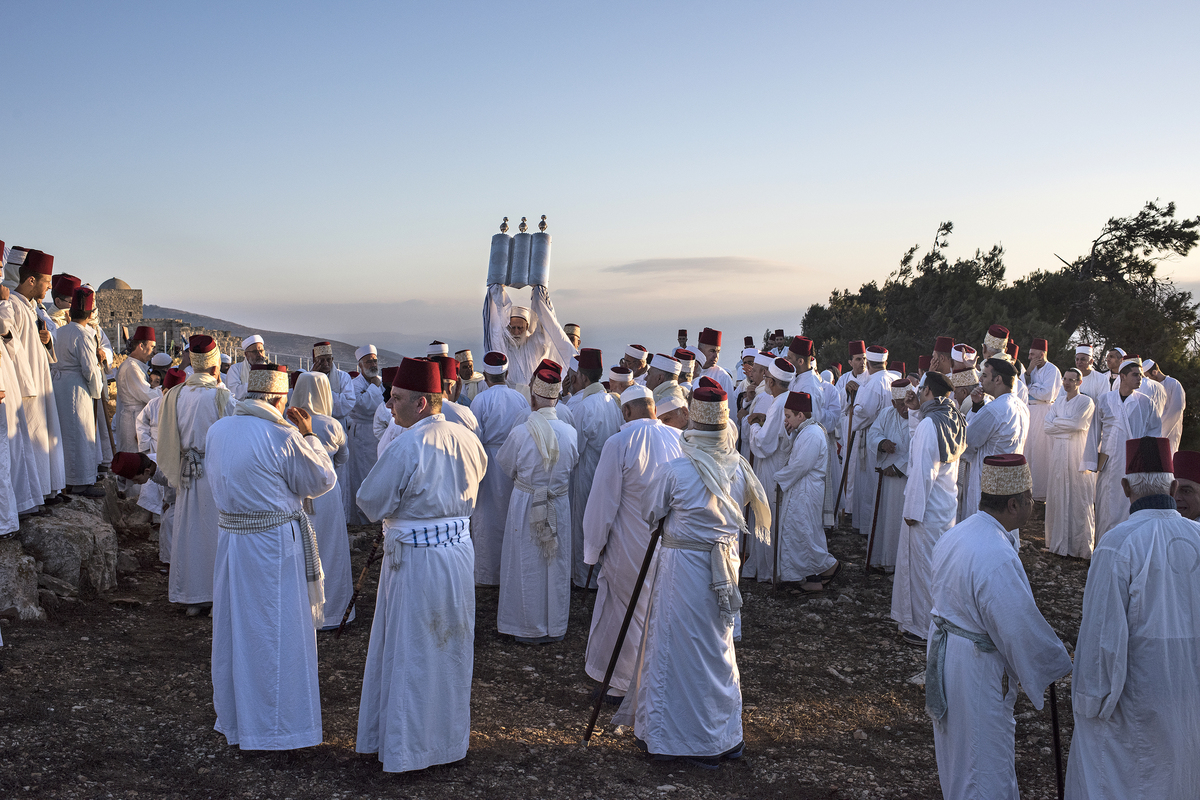
Surrounded by worshippers, a Samaritan priest on Mountain Gerizim thrusts a silvery-plated Torah scroll toward the heavens.
Tanya Habjouqa/Noor Images for NPR
Whom to trust?
Many Samaritans I spoke to in the mountain village believed one of their own was complicit. Merely Benny, my guide to the Samaritan community, had warned me about the healthy imagination of the Samaritans on the mount. He believed what a local Palestinian in Nablus told him, that a group of Palestinians from the city had stolen the Torahs to sell them on the antiquities market. He was convinced that no Samaritans were involved.
Benny and I met over croissants in Jerusalem, and I told him what I had heard on the mountain, that members of his ain customs had secretly sold the Torahs.
"No such thing ever occurred," Benny said. "What's the signal when everyone becomes a Sherlock Holmes?" The era of destitute Samaritans selling holy texts in the 19th and early on 20th centuries was long over, he insisted. "So, they sold because they didn't have. Now, nosotros accept. So why would a Samaritan sell?" he asked.
Benny was in Jerusalem that day for an appointment. An auction firm had bought a pile of 18th and 19th century Samaritan manuscripts from a private collector and asked Benny to catalog them for an upcoming auction. I sat next to Benny at the sale house every bit he shuffled through the documents and offered his standard explanation: Impoverished Samaritans had been compelled to sell their manuscripts for food a long time ago.
Benny so revealed a item I hadn't heard before: His gramps'south brother had also been complicit in the Samaritan manuscripts marketplace. To cover debts, he sold a 15th century Torah codex to Yitzhak Ben-Zvi, the second president of State of israel. His great-grandfather was enraged, became ill and died, and information technology is however a source of shame for Benny.
Every bit Benny and I left the sale house, I asked him why he would lend a paw to the auctioning of Samaritan treasures. "Can I end it?" he shrugged.

Tsedaka in the Washington, D.C., area during ane of his annual trips around the earth to visit Samaritan manuscript collections and lecture most the Samaritans. Claire Harbage/NPR hibernate caption
toggle explanation
Claire Harbage/NPR
Weeks later, Benny returned to the auction house with his completed catalog. I joined him. His typewritten inventory included a detailed description of the texts and the dollar value of each. A small leatherbound prayer volume was worth $lxxx,000, Benny estimated, while other pieces ranged from a few hundred dollars to a few m. The possessor thanked Benny for his work, agreed to give him a commission on the eventual auction sales and handed him a wad of bills as bounty for his work.
Benny was involved in the Samaritan manuscripts market in other ways, too. An antiquities dealer told me Benny tried to interest him in a manuscript; Benny said he was simply trying to help a human in dire fiscal straits sell his Samaritan manuscript drove. And Benny had expected to become a cut of the deal for the return of the stolen Torahs, though he subsequently demurred on the subject of a financial reward, proverb the render of the manuscripts was paramount.
When I first joined Benny on the hunt for the missing manuscripts, I saw him equally a protector of his people's cultural heritage. Now I wondered if he was any different from the enterprising Samaritan salesmen in generations past. He publicly opposed Samaritans trading in their own manuscripts fifty-fifty as he helped enable the trade past consulting for auction houses and dealers.
"Hey, I'm non looking for that," he said. Meaning, he wasn't fishing for profits. "[The dealers] are making the initiative. So my involvement is that at least they will accept the right information." He said he does not initiate the sale of manuscripts but offers his services if asked. "I'k not a dealer. Simply dealers ask me from fourth dimension to time. And they pay [me] according to the law," he said. "At least I'yard not helping purchase them. I'm not."
"It doesn't hurting you that these things are beingness sold?" I asked.

Tsedaka believes Samaritan manuscripts are better off out of Samaritan hands and in the custody of professional, climate-controlled libraries. Claire Harbage/NPR hide caption
toggle caption
Claire Harbage/NPR
"I'm non lamentable," he said.
He argued that Samaritan manuscripts were better off out of Samaritan easily. Serious collectors and climate-controlled libraries had the resources and know-how to preserve the brittle manuscripts amend than his community could, while Benny offered his cognition and then the texts could be properly documented. As Benny saw it, these texts scattered effectually the world served a purpose: They piqued scholars' interest and kept the story of the Samaritans alive. Paradoxically, their plunder ensured their preservation.
The other paradox remained: Benny supported the very trade he opposed. Some Samaritans told me privately that they think Benny exploited their religion to finance his annual lecture trips around the globe, while Benny reserved similar disapproval for those Samaritan priests who hawked amulets and psychic readings to gullible outsiders.
And still, for this tiny religious minority concerned with survival, cultural preservation is cocky-preservation. Living among warring Israeli and Palestinian societies requires pragmatism, and and so does the conservation of their literary treasures.
"If the deal goes through"
A few years ago, I attended a public auction in Tel Aviv where a few Samaritan items were on auction, to see who might bid on them. One man who did was an ultra-Orthodox Jewish antiquities dealer named Menachem, who asked to exist identified in this story only by his beginning name. He said he was a middleman for the Greenish family unit of Oklahoma Metropolis, the owners of the Hobby Lobby arts and crafts chain. Over the past decade and a half, the evangelical Christian family has clustered 1 of the world's largest collections of biblical artifacts — nigh 40,000 antiquities and manuscripts. The Greens have likewise been accused of fueling the black market in antiquities; last year they paid a $3 1000000 federal fine for illegally importing ancient Iraqi artifacts and agreed to forfeit the objects.
Three rare Samaritan manuscripts are on display in the Greens' new $500 million Museum of the Bible in Washington, D.C., including a fragment of i of the world's oldest existing Samaritan Torah scrolls. It should come as no surprise that Benny had a paw in the sale of the Torah fragment; he said he catalogued it — free — for Sotheby'southward, and the auction business firm sold it to the Greens.

Three rare Samaritan manuscripts are on display at the new Museum of the Bible in Washington, D.C., including a fragment of i of the world's oldest existing Samaritan Torah scrolls. Claire Harbage/NPR hide caption
toggle caption
Claire Harbage/NPR
Menachem, the antiquities dealer, said he was curious to meet a Samaritan, so I introduced him to Benny. Later, Menachem told me he and Benny had come up with a proposal to reach back out to the frontman in Amman to buy the stolen Samaritan Torah scroll for the Museum of the Bible, with the Samaritan community's blessing. "If the deal goes through, I will give you, God willing, v percent of the amount of the purchase," Menachem wrote me in a text message. I declined the offer.
Benny tried to persuade the high priest to let the museum buy the scroll and lend information technology to the Samaritans periodically. The high priest declined. He said he wanted the gyre returned to the customs, not lent back, and the deal never went through. The Museum of the Bible'south director of collections, David Trobisch, said he was unfamiliar with the affair. "This may relate to a contact five years agone that I decided not to pursue," Trobisch said in an email. When the loftier priest declined the offering, Benny threw up his easily. Besides, he realized that his efforts over the past 23 years to get the Torahs back had made some Samaritans question his motives. "This is what made the Samaritans think if Benny is struggling so much [to observe the manuscripts], possibly he has millions to brand from this," Benny said — an accusation he denied.
"No doubt this is it"
A couple of weeks ago, an Israeli military official sent me a picture of a unmarried leaf from an erstwhile Samaritan scroll. Information technology had been confiscated several years agone from a traveler crossing the Jordanian border. I immediately sent the picture to Benny. He compared the leaf with images of the stolen Torah scroll. "No doubtfulness this is it," he replied. His heart defenseless the first poetry at the tiptop of the leaf, a passage from Deuteronomy: "You shall not evangelize a slave to his principal if he seeks refuge with you from his master."

A leaf from an old Samaritan scroll confiscated past Israeli community officials at the Jordanian border. Run into the full text. COGAT/Israeli Ministry of Defense hide explanation
toggle caption
COGAT/Israeli Ministry building of Defense
Five years later setting out on my quest for the missing Torahs, I still do non know whether Samaritans were responsible for their disappearance — merely I now know they won't get them back whole. The codex said to be in London has vanished, perhaps tucked abroad in some collector'due south bookshelf.
The Torah roll is being sold piecemeal, its parchment leaves separated at the seams. The Israeli officeholder in possession of the single confiscated leaf told me he has no intention of giving it dorsum to the Samaritans. Co-ordinate to policy, State of israel does not render antiquities to areas of the West Bank under Palestinian control, and the Samaritans' West Banking company hamlet is under partial Palestinian jurisdiction.
Who is to blame for the Samaritans not getting back their holy books? Benny believes the community did not wish to revisit Palestinians' potential involvement in the theft, which could threaten the Samaritans' frail relations with their neighbors. The high priest says he was not willing to lose buying of the Torah scroll by assuasive a museum to purchase information technology. And community members were clearly uncomfortable investigating prominent Samaritans who may have helped orchestrate the theft. Whatever the reason, the Samaritans sacrificed their hazard to recover the very Scriptures their ancestors had protected for centuries.
Final October, I left Jerusalem in the pitch dark and drove north, past Palestinian hamlets and Israeli settlements, to attend the Samaritans' sunrise pilgrimage ceremony for the biblical Festival of Tabernacles. At 5:thirty in the morning, men in tasseled white robes and ruddy tarboosh caps streamed to the rocky peak of Mount Gerizim, the rap of their wooden canes punctuating the wails of quarter-tone prayers. Surrounded by several hundred men who might have answers to the Samaritan mystery, I couldn't resist striking up conversations on the edges of the crowd.
Benny approached me, his robe worn casually open over a night bluish sweater. "Enough with the interrogations," he said. It was prayer fourth dimension. The rise sun turned the black heaven orangish, and so calorie-free blueish. Men encircled a bearded priest for the climax of the prayers. In the sea of white robes, I recognized the faces of those who had confided in me over the years most the robbery. They waved a hand over their faces in deference as the priest unfurled a Torah curlicue and raised it high.
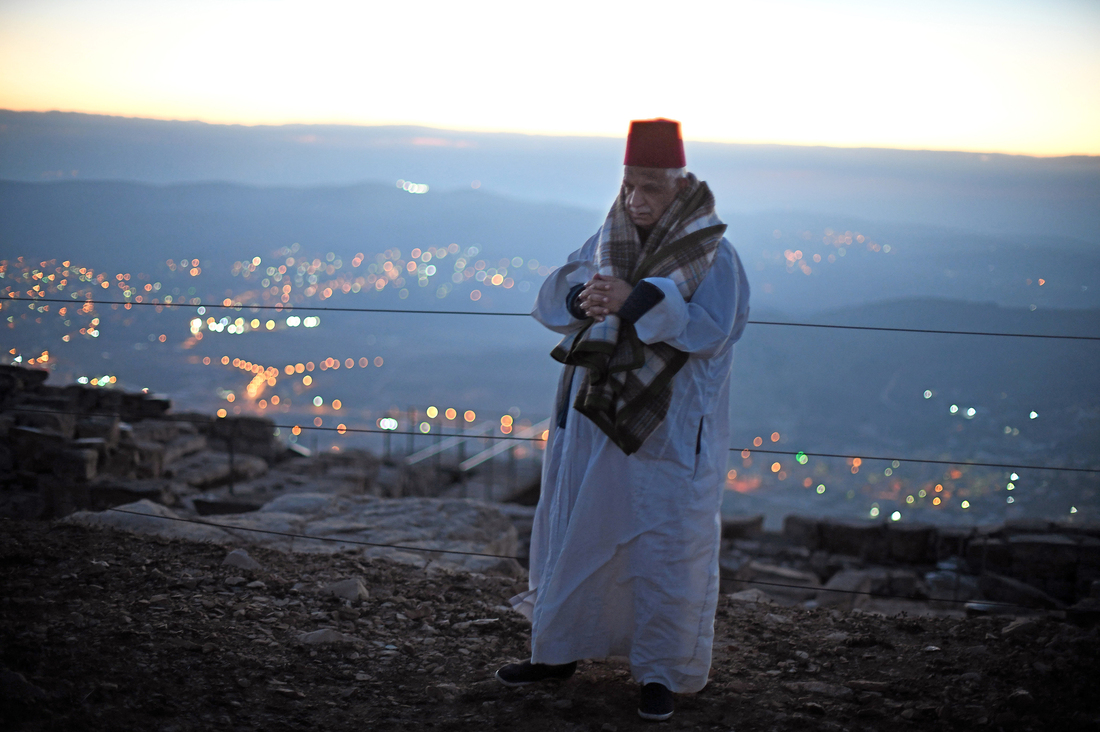
Tsedaka walks at the top of Mount Gerizim but before sunrise. He confirmed that the single foliage in Israeli army possession from an former Samaritan scroll is probable part of the missing Torah. The whorl is beingness sold piecemeal, its parchment leaves separated at the seams. Tanya Habjouqa/Noor Images for NPR hide caption
toggle caption
Tanya Habjouqa/Noor Images for NPR
washingtonforideare.blogspot.com
Source: https://www.npr.org/2018/04/29/602836507/who-stole-the-torahs
0 Response to "Cover Art Three Months Residence at Nablus and an Account of the Modern Samaritans"
إرسال تعليق